Understanding Hair Loss
Receding Hairline: Normal Maturing or Balding?
Is your hairline maturing or is it male pattern baldness? What the research says about temple recession, the signs worth watching, and what to do next.
You look at an old photo, then at the mirror, and your hairline has moved. Is that ordinary growing up, or the start of male pattern baldness?
Short answer: some change in the hairline is normal. Hairlines change shape from childhood into adulthood, and in one community survey nearly every adult man had some recession at the temples. What matters is the direction: a hairline that settles and stays put is behaving differently from one that keeps moving back while the hair near it gets thinner. Nobody can tell the two apart from a single glance in the mirror, so the useful move is to take dated photos and look again in a few months.
What counts as a normal hairline change?
A review titled Phenotype of normal hairline maturation describes hairlines as changing in shape with age, starting at birth, as a child’s face develops into an adult’s. It discusses the range of normal front and side hairlines in men and women and proposes a system for naming the points on them. Its authors are affiliated with the New Hair Institute, a clinic, and the abstract doesn’t give a measurement you can use to call your own hairline “mature”. Treat it as support for one idea only: a hairline that differs from your teenage one isn’t automatically a disease.
How common is a receding hairline?
Very. In the Maryborough survey in Victoria, Australia, researchers mailed a questionnaire to 5,000 adults aged 20 and over, and 1,456 replied. Of those, 396 attended an examination. The authors report that 98.6% of the men had bitemporal recession, meaning recession at both temples. They also report that its severity was linked to hair loss at the vertex (crown) and mid-front of the scalp, but not significantly to age (p = 0.06, which is close to the usual cutoff, so don’t read much into the age result). Mid-frontal hair loss became more common with age overall, reaching 73.5% of men aged 80 and over. The 68 boys aged 5 to 9 who were examined all had no recession.
Limits: this was one Australian town, the authors report a response rate of 34.1%, and only 396 of those who replied came in for an examination. It shows that some temple recession is close to universal in adult men. It does not tell you where “normal” stops and “balding” starts.
Signs it may be pattern hair loss
We couldn’t find a source that gives a validated cutoff, such as a distance from the brow, that separates a mature hairline from early balding. Doctors judge it from your pattern and your history. Things worth noticing:
- It keeps moving. The hairline in photos from a year ago or two years ago is clearly higher or more deeply notched at the temples.
- The hair near it is changing. Male pattern baldness works by shrinking hair follicles under the influence of androgens (miniaturization), so look for hairs at the temples that are finer than those elsewhere.
- It isn’t only the front. Thinning at the crown or the mid-front of the scalp goes with temple recession in the Maryborough data. Check the top and back with a second mirror or a phone photo.
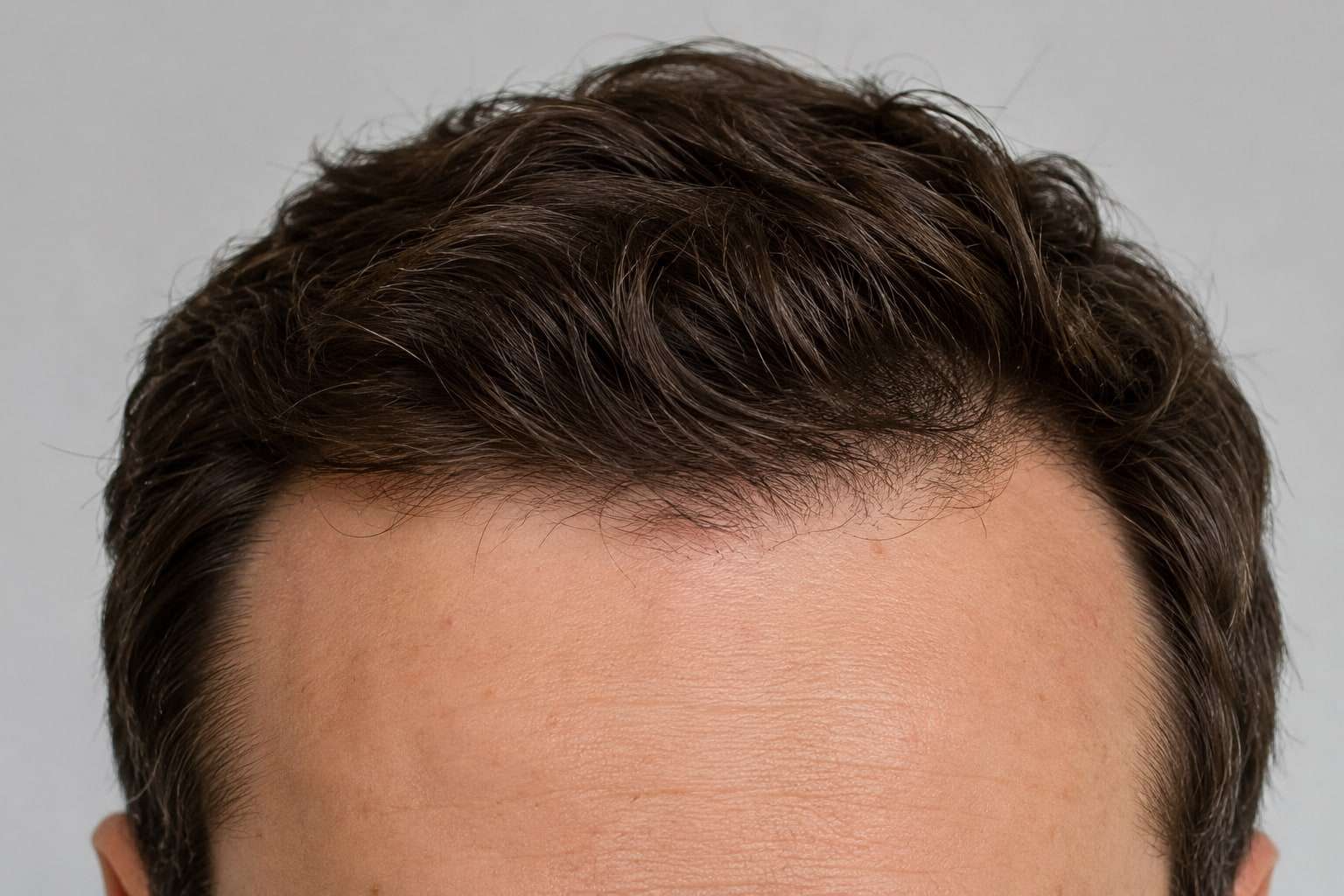
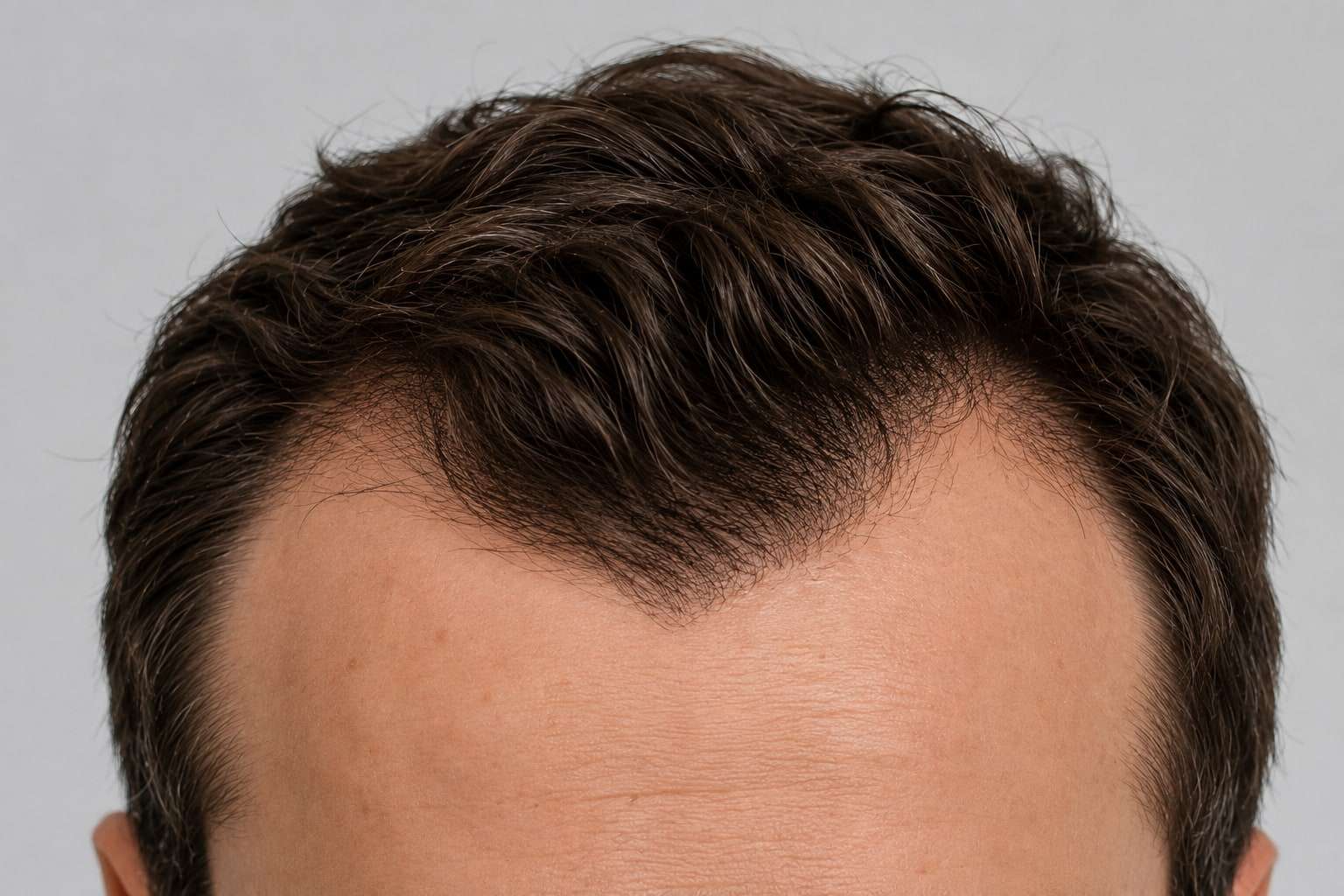
Where it sits on the Norwood scale can help you describe it. Stage 2 is minor recession at the temples, and the Norwood guide shows what each stage looks like and why the scale is a rough yardstick rather than a measurement. Our stage finder helps you pick yours.
Other reasons your hairline may look different
- Temporary shedding. Telogen effluvium thins hair across the whole scalp, usually a few months after an illness, crash diet or other shock. It typically recovers on its own, so a doctor should rule it in or out before you assume the worst.
- A scarring alopecia. Frontal fibrosing alopecia is a scarring condition that causes progressive recession of the frontotemporal hairline, seen as a hairless band and often with loss of eyebrow and body hair. A review in the Journal of the American Academy of Dermatology says it mainly affects postmenopausal women and only occasionally men. If your eyebrows are thinning along with your hairline, see a dermatologist rather than waiting.
- Tight styles. Constant pulling on the hairline can cause traction alopecia. Our guide to hair loss from tight styles explains how to tell it from a receding hairline, and our guide to haircuts for thinning hair covers styles that don’t pull.
For the full list, with a table to tell them apart, see our guide to what causes hair loss in men.
What to do about a receding hairline
- Take photos now. Use the same light, distance and angle every time, with dry, unstyled hair, and repeat every few months. Our guide to tracking hair loss explains how.
- See a doctor if it’s moving fast, you’re young, or something else looks off. A dermatologist or other clinician can tell pattern hair loss from the other causes above.
- If it is pattern hair loss, know what has been tested at the front. Treatments are not equally studied at every part of the scalp. A one-year, double-blind, placebo-controlled trial of finasteride 1 mg a day in men with thinning at the front and mid-scalp found a significant increase in frontal hair count, plus better patient and investigator ratings, with benefit maintained or improved in a one-year open extension. The abstract doesn’t report the number of men or the funder. The larger pair of finasteride trials counted hair at the vertex, so they say less about the front. Finasteride is a prescription drug with known side effects, so read our finasteride guide and talk to a prescriber. For topical treatment, a 48-week trial of 393 men aged 18 to 49 found 5% minoxidil better than 2% minoxidil and placebo at increasing hair regrowth. The abstract doesn’t break results down by area of the scalp. See our minoxidil guide.
- Compare all the options. Our overview of how to stop hair loss puts them side by side.
If your hair loss is advanced and treatment isn’t enough, surgery is another route: see our guide to the hairline transplant.
Whatever you decide, a receding hairline is common, and choosing to do nothing, to treat it or to cut it short are all fine choices.
The bottom line
Hairlines change, and some recession at the temples is close to universal in adult men. What deserves attention is a hairline that keeps moving, with finer, shorter hair around it, or one that comes with eyebrow loss or scalp changes. Photograph it, give it a few months, and talk to a doctor if the photos show a trend. If you want to act early, finasteride and minoxidil are the best-studied medical options, and both are covered in our guides.
Sources
- Prevalence of male and female pattern hair loss in Maryborough (Survey, Journal of Investigative Dermatology Symposium Proceedings, 2005)
- Phenotype of normal hairline maturation (Review, Facial Plastic Surgery Clinics of North America, 2013)
- Finasteride in the treatment of men with frontal male pattern hair loss (Randomized controlled trial, Journal of the American Academy of Dermatology, 1999)
- A randomized clinical trial of 5% topical minoxidil versus 2% topical minoxidil and placebo in the treatment of androgenetic alopecia in men (Randomized controlled trial, Journal of the American Academy of Dermatology, 2002)
- Finasteride in the treatment of men with androgenetic alopecia. Finasteride Male Pattern Hair Loss Study Group (Randomized controlled trial, Journal of the American Academy of Dermatology, 1998)
- Frontal fibrosing alopecia part I - Diagnosis and clinical presentation (Review, Journal of the American Academy of Dermatology, 2026)
This article is for education only and is not medical advice. Talk to a doctor or dermatologist before starting or changing any treatment. Medical disclaimer