Hair Transplant
Hairline Transplant: Grafts, Cost and What a Natural Result Takes
What a hairline transplant involves, what makes the result look natural or not, what it costs, and the questions to ask a surgeon before you book.
A hairline transplant moves hair from the back and sides of your head to the front, to rebuild a hairline that has receded. The short answer: it uses your own donor hair, and surgeons’ own reviews stress that the design of the hairline matters as much as the technology. Published prices run from about $2,000 to $16,000 depending on country and clinic (see our hair transplant cost guide).
This page covers the hairline specifically. For prices by country, start with the cost guide. For the methods used to harvest grafts (FUE and FUT), the cost guide explains the difference.
What is a hairline transplant?
A hairline transplant is a hair transplant aimed at the front of the scalp: the hairline itself, often with the temples and the area just behind it. A 2025 review in Dermatologic Surgery describes hair transplantation as a minimally invasive treatment based on donor dominance, meaning hair taken from the back of the head tends to keep growing after it’s moved. The same review calls follicular unit excision (FUE) and linear strip excision the state-of-the-art ways to harvest grafts, and concludes that better devices, techniques and medical therapies have supported long-lasting, natural results and high patient satisfaction.
Two things follow from that. The hair you move comes from a limited supply, your donor area. And a transplant moves hair; it doesn’t treat the loss around it.
Who is a hairline transplant for?
What matters most is the donor hair you have. The StatPearls chapter on hair transplantation gives these reference points for the donor area: the safe zone at the back of the head typically holds 65 to 85 follicular units per cm²; areas above 80 are described as excellent candidates, and densities below 40 as less suitable. It describes ideal candidates as having a clear, stable pattern of hair loss and realistic expectations, and it advises against grafting only the crown, because that can use up donor grafts too soon.
Two situations are worth separating:
- A maturing hairline, not baldness. Hairlines change shape between childhood and adulthood, as a review of normal hairline maturation describes. Before you consider surgery, work out which one you have. Our guide to the receding hairline explains how.
- Hair loss that is still moving. Grafts are a limited supply, so the plan has to allow for further loss. The Norwood scale helps you place yourself, and a dermatologist can judge how fast it’s moving.
If your main complaint is a hairline that sits too high on the forehead rather than hair loss, there is a different operation: hairline-lowering surgery. A 2020 review presents it as an alternative to transplantation, with high density and immediate results, but says suitable candidates need a stable frontal hairline and a scalp mobile enough to be advanced, which the authors note rules out most men. It’s a more invasive procedure, aimed at hairline height rather than at hair loss.
What makes a hairline look natural?
This is the question that matters most, and the evidence on it is thin. The research that exists is small, but it points the same way.
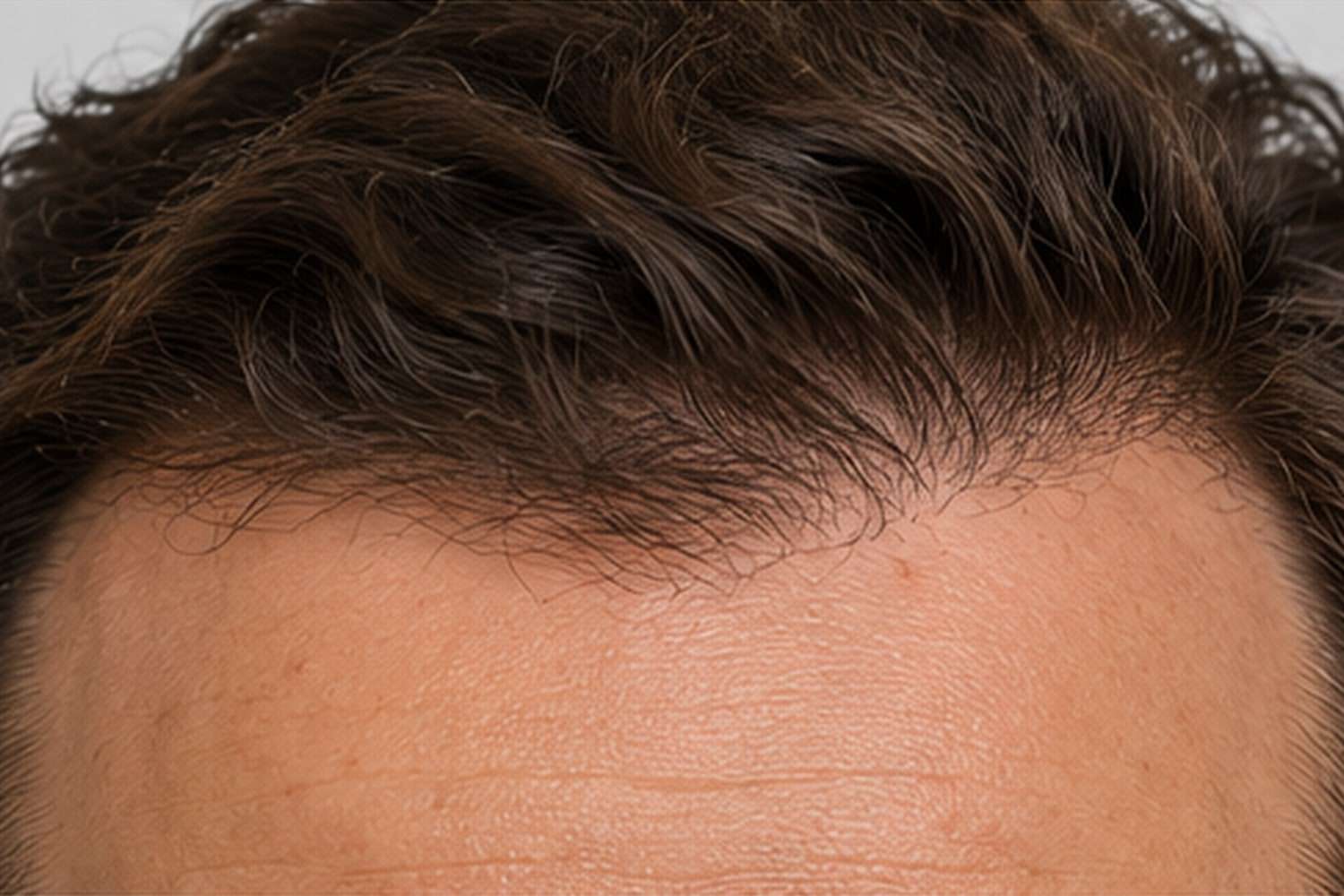
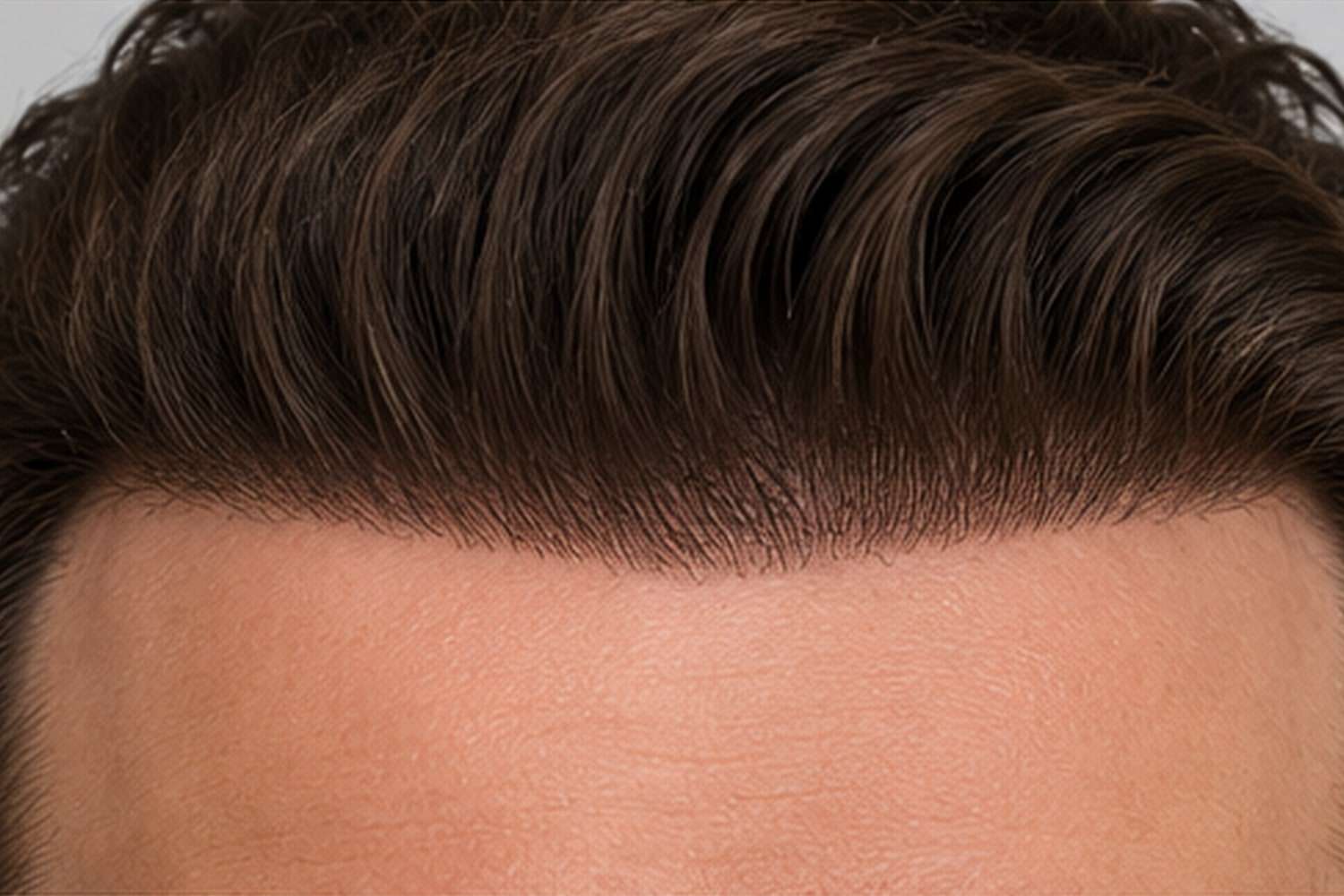
A gradual transition. A 2026 study of surgeons repairing bad hairlines says a well-designed frontal hairline needs attention to density, shape and a gradual transition from fine to thick hair. The StatPearls chapter likewise tells surgeons to design a conservative, natural hairline for a lasting, realistic result.
Some asymmetry. Many patients assume a perfectly symmetrical hairline looks best. A 2025 study measured the direction hairs grow along the hairline in 125 East Asian men aged 20 to 35 with Norwood stage II hair or better. The angle averaged 55.0 degrees on the right side and 32.8 degrees on the left, a rightward skew of 22.2 degrees, and only 11 of the 125 men (8.8%) had the opposite pattern. The authors conclude that hairline designs that are fully symmetrical, with hairs angled the same way on both sides, may look unnatural. Limits: it used 2D photographs, only one ethnic group, and a design recommendation is not the same as a measured outcome. It tells you what natural hairlines look like, not how happy patients were afterwards.
What goes wrong. The repair study in the next section describes unhappy patients whose hairlines were excessively low, rounded or lacking a natural transition.
What happens when it goes wrong?
The StatPearls chapter lists infection, scarring, graft failure, unnatural-looking hairlines and temporary “shock loss” among the risks to review with a surgeon.
The best picture of what a bad hairline looks like, and how hard it is to fix, comes from a 2026 multicenter study from Spain. It followed 20 men, median age 37.5, who were unhappy with an earlier hairline that was excessively low, rounded or lacking a natural transition. They had the unwanted hairs removed with FUE. Results:
- About four in five (79%) showed no visible scarring or pigment change at 6 to 12 months.
- 28% needed a second corrective procedure.
- 95% were rated satisfied or very satisfied with the result. The summary calls this patient-reported, but the methods describe the surgeons giving the rating.
- Cutting out grafts that had already been transplanted was harder than a first procedure: damage to the hair units during extraction was more common than the surgeons usually see, because scar tissue and odd angles complicate the work.
This is a small, retrospective study with no control group, run by the surgeons who did the repairs, and satisfaction wasn’t measured on a validated scale. It doesn’t say how many men end up needing repair. It does show that fixing a hairline is its own specialty.
Complaints also show up in court. A 2026 review of North American hair transplant lawsuits found 35 cases decided between 1980 and 2026. Inadequate informed consent was alleged in 17 (48%), unnatural-looking hair or hairline in 5 (14%) and scarring in 13 (37%). Misleading statements by surgeons were alleged in 11 and by advertising in 5. The authors’ conclusion is that clear communication about risks, outcomes and who does what may reduce disputes. The review only covers public court records, so it can’t tell you how common problems are overall.
Who should do it?
A 2020 review of robotic hair transplantation makes a point that applies to every technique: technology doesn’t replace careful candidate selection, hairline design, or judgment about where hair should go. The 2025 state-of-the-art review also credits thoughtful hairline design and concurrent medical management with better results.
In practice, before you pay a deposit:
- Meet the surgeon who will design the hairline. Ask who draws it, who removes the grafts and who places them.
- Ask for a design that fits you, including how far forward the hairline will sit, how it will blend at the temples, and what you’ll do if your hair loss continues.
- Ask how many grafts the plan uses and how many are left in your donor area afterwards.
- Ask for the risks in writing, including scarring, shock loss and what happens if you want a repair.
- Look at results on men with a similar starting point, with before and after photos taken in the same lighting.
How much does a hairline transplant cost?
It depends on the graft count, the technique, the surgeon and where you have it done. Based on prices clinics published in October 2026, our cost guide found roughly $4,400 to $10,600 in the US, £3,200 to £12,000 in the UK for about 2,000 grafts and €1,800 to €6,000 in Turkey for an all-inclusive package, before flights. Those are advertised prices, not what patients paid, and the guide explains how to compare quotes and why the cheapest is not always the cheapest result.
Protecting the hair you keep
A transplant doesn’t stop pattern hair loss in the rest of your scalp. The 2025 review above attributes part of today’s better results to medical treatment given alongside surgery. Both finasteride (prescription, so a prescriber should go through side effects with you) and minoxidil are covered in our guides, and how to stop hair loss lays out the options side by side.
The bottom line
A hairline transplant can rebuild a receded hairline with your own donor hair, and the quality of the design matters as much as the technique: a gradual transition, a conservative position and some natural asymmetry. The risks are real, so get them in writing: scarring, graft loss and an unnatural line that can take a specialist to fix. Make sure your hair loss is settled enough to plan for, pick the surgeon before the price, and keep treating the rest of your scalp.
Your next step: place yourself on the Norwood scale, then read the cost guide before you book consultations.
Sources
- Hair Transplantation: State of the Art (Review, Dermatologic Surgery, 2025)
- Hair Transplantation (Review, StatPearls, 2025)
- FUE for the repair of unnaturally designed or low hairlines in men with androgenetic alopecia: a retrospective, multicenter observational study (Study, Frontiers in Medicine, 2026)
- Natural Asymmetry in Hair Growth Direction: Implications for Hairline Design in Male Patients (Study, Journal of Craniofacial Surgery, 2025)
- Robotic Hair Transplantation (Review, Facial Plastic Surgery Clinics of North America, 2020)
- Hairline-Lowering Surgery (Review, Facial Plastic Surgery Clinics of North America, 2020)
- Phenotype of normal hairline maturation (Review, Facial Plastic Surgery Clinics of North America, 2013)
- Medicolegal Issues in Hair Transplantation: A Review of North American Court Decisions and Canadian Regulatory Complaints (Review, Journal of Cosmetic Dermatology, 2026)
This article is for education only and is not medical advice. Talk to a doctor or dermatologist before starting or changing any treatment. Medical disclaimer