What Is Traction Alopecia? Hair Loss From Tight Hairstyles
Traction alopecia
Traction alopecia is hair loss caused by styles that pull on the hair day after day. Caught early, loosening the style can reverse it; years of it can scar.
- Loose styleNo steady pull on the root
- Tight, every dayConstant pull on the root. Reversible if you loosen it early
- Years of itThe follicle can scar and stop for good
At a glance
- Cause
- Repeated tension on the hair from tight styles
- Treatment
- Take the tension off the hair
- Outlook
- Reversible early, can become permanent scarring
- How common
- 22.6% of 874 adults in one Cape Town survey
- In men
- 2.2% in that survey; also reported under turbans
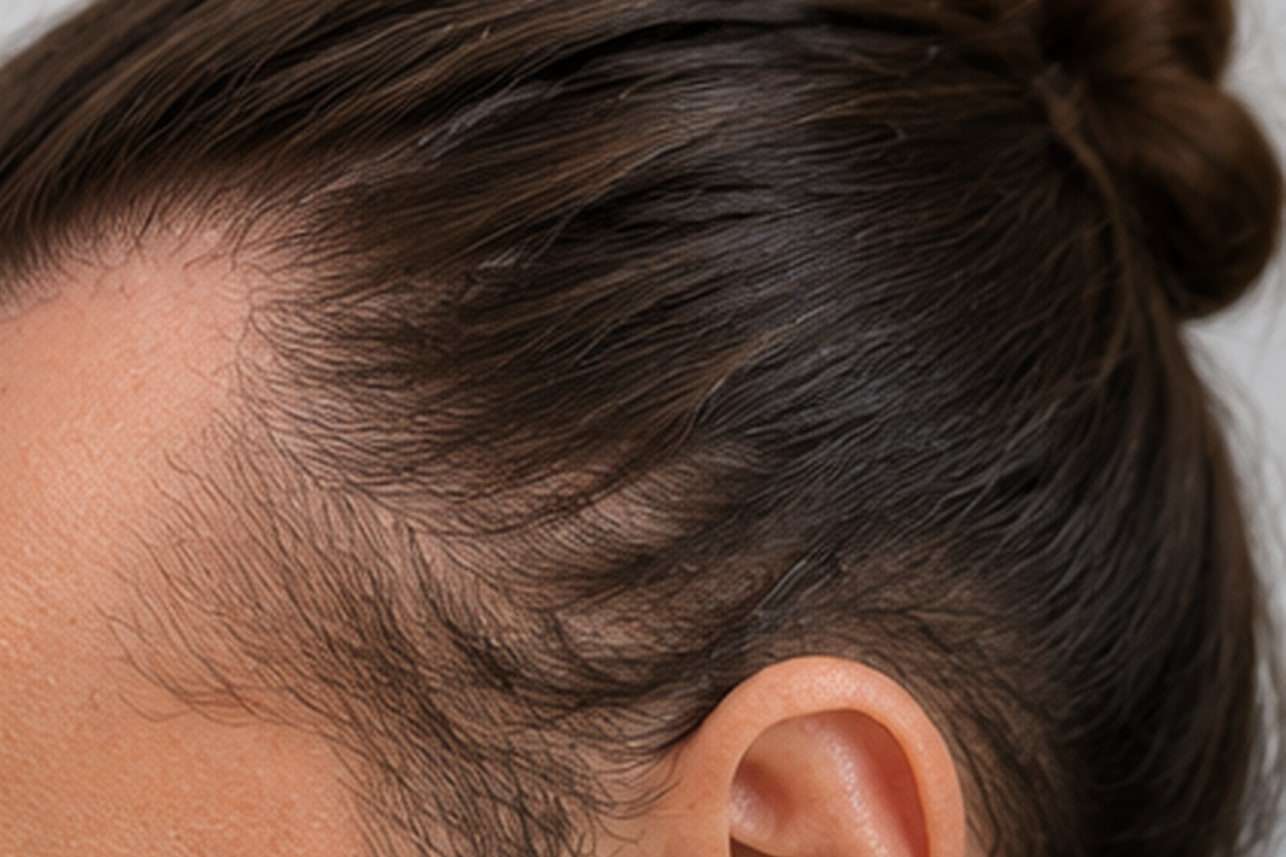
Traction alopecia is hair loss caused by the way hair is worn, not by genes or hormones. Styles that apply tension to the follicle over and over, such as tight braids, ponytails, buns and extensions, can make hair fall out where the style pulls. The same review stresses the timing: caught at its reversible stage, it can be stopped before it becomes permanent scarring.
Who gets it
It is far more common in women, but men get it too. In a survey of 874 adults in Cape Town, with scalp examinations, 22.6% had traction alopecia: 31.7% of the women and 2.2% of the men. It was most common in people who usually wore extensions attached to chemically relaxed hair (48%). A review in the Journal of the American Academy of Dermatology sorts common styling practices into high, moderate and low risk. Among men, a case report describes it in Sikh men from the steady tension of hair tied under a turban.
How it differs from male pattern baldness
Male pattern baldness is typically genetic and follows its own pattern at the temples and crown, whatever you do with your hair. Traction alopecia is caused by the pulling itself, so it shows up where a style pulls hardest, and it is treated by decreasing tension on the hair. You can have both at once. If you can’t tell which you have, a dermatologist can, and it matters, because only one of them goes away when you change your hair.
What to do about it
Loosen the style, change where it pulls, and give your hair days off. Our guide to haircuts for thinning hair covers styles that don’t pull. Hair that is already gone after years of tension may not come back, which is why thinning where a style pulls is worth acting on as soon as you notice it.
Published by the Say No to Baldness editorial team
Related terms
Sources
- Review of traction alopecia in the pediatric patient: Diagnosis, prevention, and management (Review, Pediatric Dermatology, 2021)
- Hairdressing and the prevalence of scalp disease in African adults (Study, British Journal of Dermatology, 2007)
- All hairstyles are not created equal: What the dermatologist needs to know about black hairstyling practices and the risk of traction alopecia (TA) (Review, Journal of the American Academy of Dermatology, 2016)
- Traction alopecia in Sikh male patients (Study, Journal of the American Board of Family Medicine, 2007)
- Hair Loss: Diagnosis and Treatment (Review, American Family Physician, 2024)