Understanding Hair Loss
Traction Alopecia in Men: Causes, Early Signs and Will It Grow Back?
Tight buns, ponytails, braids and turbans can pull hair out. How to spot traction alopecia early, how it differs from balding, and when the hair comes back.
Short answer: traction alopecia is hair loss caused by a hairstyle or headwear that pulls on the same hairs day after day: tight buns, ponytails, braids, extensions, a tightly tied turban. Men get it far less often than women, but they do get it. Caught early, it usually grows back once you take the tension off. Left for years, it can scar, and scarred follicles don’t come back on their own.
The good news is that this is a kind of hair loss you can largely switch off yourself. Here’s how to tell if you have it, how it differs from male pattern baldness, and what to do.
What is traction alopecia?
It’s hair loss from mechanical pulling. A 2018 review from the University of Miami explains the mechanism: excessive pulling damages the hair follicle, the damage sets off inflammation around it, and repeated traction over time damages the follicle again and again until the hair falls out. The longer and harder the pull, the higher the risk.
It isn’t driven by genes and hormones the way male pattern baldness is. The American Family Physician review of hair loss groups it with the focal kinds of hair loss and gives the treatment in one line: decrease the tension on the hair.
Can men get traction alopecia?
Yes, though it is much rarer than in women. In a survey with scalp exams of 874 adults in Cape Town, 31.7% of the women had traction alopecia against 2.2% of the men. The survey linked scalp conditions to hairstyles, and the men mostly wore their hair differently: 91.7% had natural (untreated) hair and most had had a haircut in the past four weeks, while most women had chemically treated hair. The highest rate, 48%, was in people whose usual style was extensions attached to relaxed hair. Most of the research since has been in women, so the numbers for men are thin.
Where the pulling comes from, in the cases the research describes:
- Tight buns and ponytails. The Miami review lists frequent tight buns or ponytails among the highest-risk styles, alongside weaves and extensions and tight braids such as cornrows and dreadlocks. If you wear long hair pulled back hard every day, this is the group you’re in.
- Turbans and hair knots. Sikh men tie their uncut hair into a tight knot and wrap a turban over it. A report in the Journal of the American Board of Family Medicine describes traction alopecia in Sikh men from the turban, and notes that treatment is hard because removing the turban for good is religiously forbidden. In Austria, doctors described two teenage Sikh brothers who had worn turbans since early childhood and developed a band of scarring hair loss along the front hairline.
- Beards tied in a knot. The Miami review notes that hair loss under the jaw has been reported in Sikh men who tie their beard into a tight knot on the chin, and an Indian case report describes treating traction alopecia of the beard with an FUE hair transplant.
- Work headwear pinned to the hair. The same review cites 143 South Korean nurses, seven of whom developed a patch of hair loss where their caps were held on with two bobby pins, after wearing them 8 hours a day for close to 10 years on average.
The risk also starts young. A review of traction alopecia in children points out that many of the high-risk styles begin in childhood, which is why it puts the weight on spotting the condition while it’s still reversible.
Early signs of traction alopecia
The hair goes where the style pulls hardest. According to the Miami review, the most common sites are the front of the hairline and the temples and sides, but any area can be hit depending on the style. The StatPearls chapter on traction alopecia names the temples and the area in front of the ears as typical tension points. In women who wore a tight ponytail for years, the Miami review notes, the loss was mostly at the front and the temples.
Signs to watch for, from those two reviews:
- Redness and small bumps or pimples around the hairs where the style pulls. The Miami review calls this the earliest sign.
- Broken hairs of different lengths and lower density in the pulled area.
- Tenderness, itching, tingling or a headache from the style. Pain matters: in the studies the review cites, only 18.9% of people with traction alopecia said they had never had painful symptoms during or after hairdressing.
- A thin fringe of short hairs left at the very edge of a thinning hairline (see the next section).
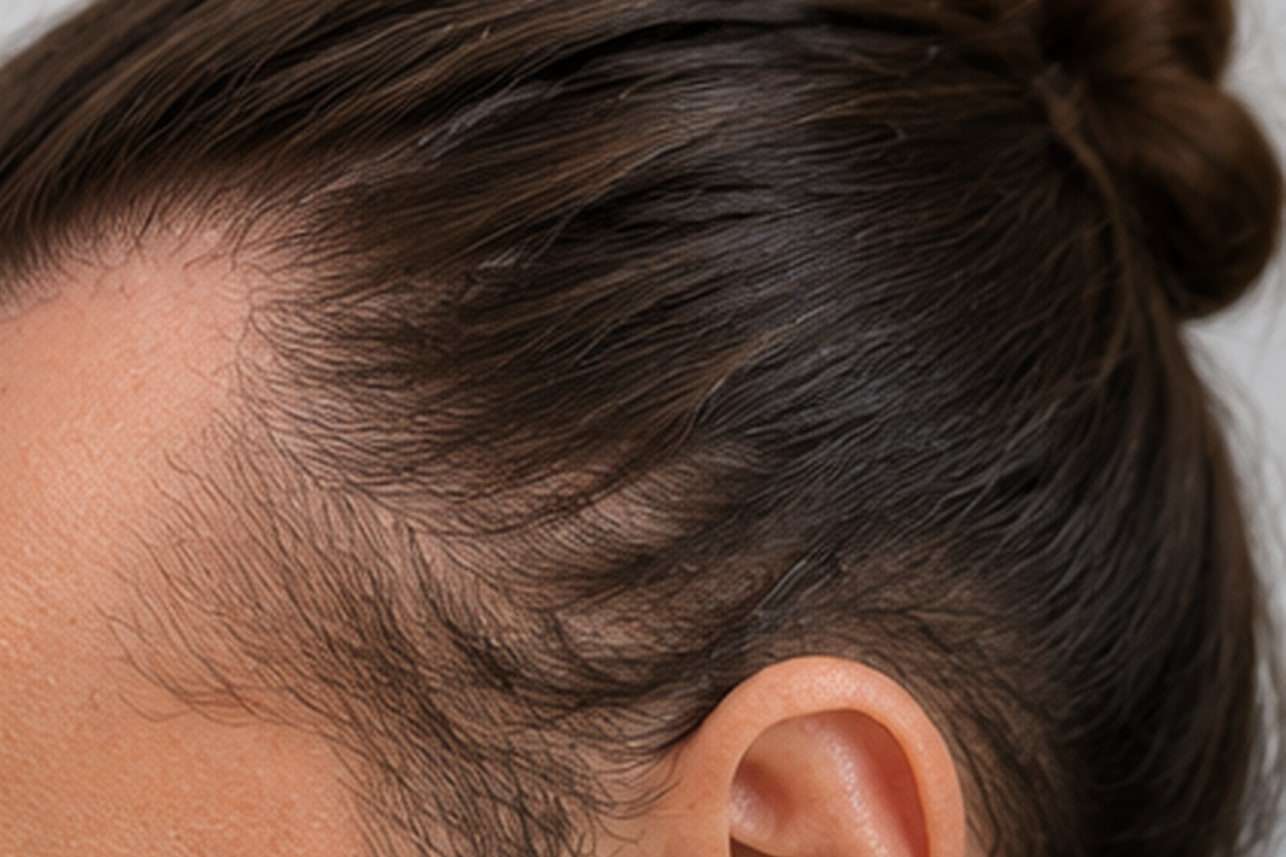
Two dermatologists who study the condition, in a paper on public education, boiled the advice down to a slogan: “tolerate pain from a hairstyle and risk hair loss.” If a style hurts, it’s pulling too hard.
Traction alopecia or a receding hairline?
Both can show up at the temples, so it’s easy to mix them up. A few differences help:
- Where it is. Male pattern baldness follows its own pattern at the temples and crown whatever you do with your hair (our receding hairline guide shows what that looks like). Traction alopecia follows the style: around the edges it pulls on, above the ears, or a patch where pins or a knot sit.
- The fringe sign. In a UCSF review of 41 women with traction alopecia, 85% had a rim of short, retained hairs along the front or temple hairline, and all of those whose hairline was affected had it. The authors called it the “fringe sign” and found it in early and late cases. The study was small and only in women, but it’s the clue a dermatologist will look for.
- What it does when you change the style. Early traction alopecia improves once the pulling stops. Pattern baldness doesn’t care how you wear your hair.
You can also have both at once. In a Johns Hopkins chart review of 66 Black women treated with minoxidil, 28.8% had pattern hair loss and traction alopecia together. If you aren’t sure which you have, a dermatologist can tell, by looking at the scalp, often with a dermatoscope (a magnifying lens), and sometimes with a small biopsy. Under the dermatoscope, the Miami review notes, little tubes of loosened root sheath stuck around the hairs, called hair casts, are a sign the pulling is still going on. For the full list of possible causes, see what causes hair loss in men.
Does traction alopecia grow back?
It depends on how early you stop the pulling.
- Early on, usually yes. The Miami review says most cases can be reversed if the right steps are taken early, and an Iraqi clinic series of 30 women and girls concludes the same: reversible if diagnosed early, permanent scarring otherwise. In that series, though, the response to treatment was poor.
- After years of tension, maybe not. In its later stages the follicles scar, and the Miami review describes that as irreversible and not responsive to treatment. Its abstract is blunt: “Currently, there is no cure.” Stopping the pulling is what stops the damage.
What happens in real clinics is mixed, partly because people tend to come in late. In a review of 216 patients at a Bronx hospital, almost all of them women, people had been losing hair for 18 months (median) before they saw a doctor. About half came back for a follow-up, and 42.5% of those reported improvement. That’s a single retrospective study with a lot of people lost to follow-up, so take the numbers as a rough picture, not a forecast.
How to treat traction alopecia
Step 1: take the tension off
This is the treatment at every stage, according to the Miami review and the American Family Physician review. In practice:
- Wear your hair looser, and stop as soon as a style hurts.
- Change where it pulls: move the bun or ponytail around instead of tying it in the same place every day.
- Give your hair days down, with no tie at all.
- Skip extensions and tight braids on chemically relaxed hair (“no braids or weaves on relaxed hair” is the second slogan from the education paper above). The Miami review also advises avoiding chemical and heat treatments, especially combined with tight styles.
- If you wear a turban or keep your hair long for religious reasons, the Miami review asks doctors to respect the cultural importance of the practice, so a dermatologist can talk through ways to reduce the tension with you.
A 2016 review in the Journal of the American Academy of Dermatology sorts Black hairstyling practices into high-, moderate- and low-risk groups, if you want to see where your style falls. Our guide to haircuts for thinning hair covers shorter styles that don’t pull at all.
Step 2: what a dermatologist may add
These treatments are used in practice, but the evidence for them in traction alopecia is mostly case reports and expert experience. There are no large trials.
- Steroids and antibiotics for the inflammation. For the red, bumpy early stage, StatPearls lists corticosteroids, and the Miami review describes steroids applied to the skin or injected at the edge of the hair loss, plus antibiotics used for their anti-inflammatory effect.
- Topical minoxidil. The Miami review cites two women with late-stage traction alopecia whose hair grew back on 2% minoxidil after one to two years of looser styles alone hadn’t helped, plus anecdotal success in other patients. It calls for more study. More on how it works in our minoxidil guide.
- Oral minoxidil. A 2022 case report describes one woman whose traction alopecia hadn’t responded to topical minoxidil and a steroid but regrew over 11 months on low-dose oral minoxidil (plus a topical steroid for the first two months), with mild extra facial hair as a side effect. One patient is a hint, not proof. Oral minoxidil is a prescription drug, so that’s a conversation for a prescriber; our oral minoxidil guide covers what the studies show in pattern hair loss.
Step 3: a hair transplant for scarred areas
When the follicles are gone for good, moving healthy ones is the remaining option. StatPearls says longstanding cases may need a transplant, and the Miami review describes successful reports, including a 23-year-old woman whose temples were scarred by five years of a very tight ponytail and who kept 90 to 95% of the transplanted hair a year after one session. These are individual cases, and the review advises going in with realistic expectations and the likelihood of more than one session. Our hairline transplant guide covers what a natural result takes and what it costs. Stop the pulling first, or the new hair is under the same tension.
How to prevent traction alopecia
If you wear long hair, a man bun, braids or locs, you don’t have to cut it off. The aim is to stop the same hairs from being pulled hard every day:
- Tie it loosely, and if it hurts or leaves your scalp sore, it’s too tight.
- Vary the position and give your hair regular days off.
- Watch your hairline and temples. Photos taken the same way every few months make a slow change easier to see; our guide to tracking hair loss explains how.
- See a dermatologist early if you notice thinning, bumps or broken hairs where a style pulls. Early is when this is fixable.
The bottom line
Traction alopecia is hair loss you cause by how you wear your hair, and in men it mostly comes from tight buns, ponytails, braids, extensions and tightly tied turbans or beards. The fix is simple and it works best early: loosen up and change where the style pulls. Thinning or a sore, bumpy scalp where a style pulls is worth acting on now. If the hair hasn’t come back after the pulling stopped, a dermatologist can tell you whether there’s still something to treat or whether a transplant is the realistic route. And if what you’re seeing is a classic receding hairline instead, start with our guide on how to stop hair loss.
Sources
- Traction alopecia: the root of the problem (Review, Clinical, Cosmetic and Investigational Dermatology, 2018)
- Traction Alopecia (Review, StatPearls Publishing, 2025)
- Hair Loss: Diagnosis and Treatment (Review, American Family Physician, 2024)
- Hairdressing and the prevalence of scalp disease in African adults (Study, British Journal of Dermatology, 2007)
- The "Fringe Sign" - A useful clinical finding in traction alopecia of the marginal hair line (Study, Dermatology Online Journal, 2011)
- Traction alopecia: how to translate study data for public education--closing the KAP gap? (Review, Dermatologic Clinics, 2014)
- All hairstyles are not created equal: What the dermatologist needs to know about black hairstyling practices and the risk of traction alopecia (TA) (Review, Journal of the American Academy of Dermatology, 2016)
- Review of traction alopecia in the pediatric patient: Diagnosis, prevention, and management (Review, Pediatric Dermatology, 2021)
- Traction alopecia in Sikh male patients (Study, Journal of the American Board of Family Medicine, 2007)
- Traction alopecia in two adolescent Sikh brothers-an underrecognized problem unmasked by migration (Study, Pediatric Dermatology, 2011)
- Traction alopecia: assessing the presentation, management and outcomes in a diverse urban population (Study, Clinical and Experimental Dermatology, 2023)
- Traction Alopecia: Clinical and Cultural Patterns (Study, Indian Journal of Dermatology, 2021)
- Enhanced Clinical Outcomes and Treatment Adherence in Patients Using Compounded Topical Minoxidil to Treat Androgenetic and Traction Alopecia (Study, Journal of Clinical and Aesthetic Dermatology, 2025)
- Treatment of traction alopecia with oral minoxidil (Study, JAAD Case Reports, 2022)
- Successful treatment of traction alopecia of beard with hair transplantation (follicular unit extraction) (Study, Indian Journal of Dermatology, Venereology and Leprology, 2022)
This article is for education only and is not medical advice. Talk to a doctor or dermatologist before starting or changing any treatment. Medical disclaimer