Understanding Hair Loss
How to Track Hair Loss: Photos, Scalp Cameras and Limits
How to tell if hair is thinning or a treatment works: a simple photo routine, what clinics and trials measure, and what scalp cameras can and can't show.
Hair loss is slow, and your eyes and memory are bad at judging slow change. Tracking turns “I think it’s thinner” into something you can compare, and it keeps you from quitting a treatment too early or sticking with one that isn’t helping.
Short answer: take the same set of photos, in the same light, with the same hair prep, every month or so, and compare them side by side. That’s close in spirit to how clinics and trials track hair loss. A scalp camera can add a closer look, but we found no study showing that consumer scalp cameras measure hair density accurately, so treat their numbers as rough.
What do clinics and trials measure?
In the two 1998 finasteride trials, which enrolled 1,553 men aged 18 to 41, efficacy was judged four ways: scalp hair counts, the patients’ own assessments, the investigators’ assessments, and review of photographs by an expert panel. The hair count was taken in a 1-inch-diameter (5.1 cm²) circle on the balding vertex. All four measures pointed the same way. The lead author was at Merck, the drug’s maker, so read it with that in mind.
Two takeaways for you. First, photos are one of the standard tools, not a second-rate substitute. Second, what you feel and what a camera sees can differ, so write down both.
How do you take photos you can actually compare?
A 2025 guide from a UK dermatology working group points out that standardized protocols for hair loss photography have been lacking, and sets out protocols clinicians can use even without a medical photography unit. The abstract doesn’t list the details of those protocols, and the full text is paywalled, so we can’t tell you their exact views or settings. The routine below is our own practical suggestion, built on the same idea: change as little as possible between photos.
- Pick one spot and one light. Same room, same window or lamp, same distance from the mirror or tripod.
- Use the same hair prep every time. Dry hair, same part, same comb direction, so you’re comparing your hair and not your styling.
- Shoot the same views. Hairline from the front, both temples, the top of the head looking down, and the crown from above (a second person or a phone on a stand helps).
- Use the same camera and settings. Turn off beauty filters, and don’t zoom differently each time.
- Do it on a schedule. Monthly is plenty. Name the files by date and keep them in one album.
- Compare in pairs. Put this month beside the first photos, not beside last month.
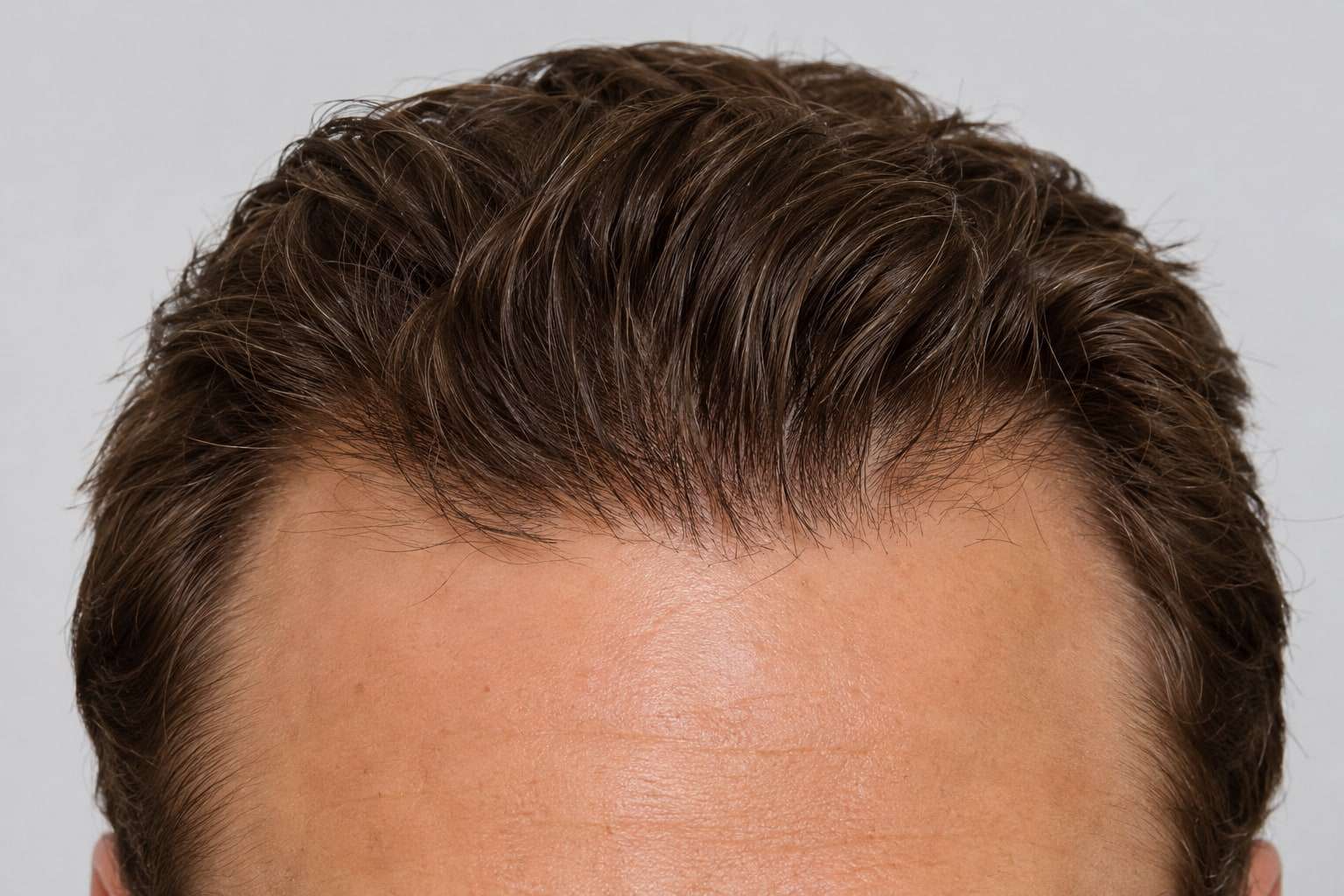
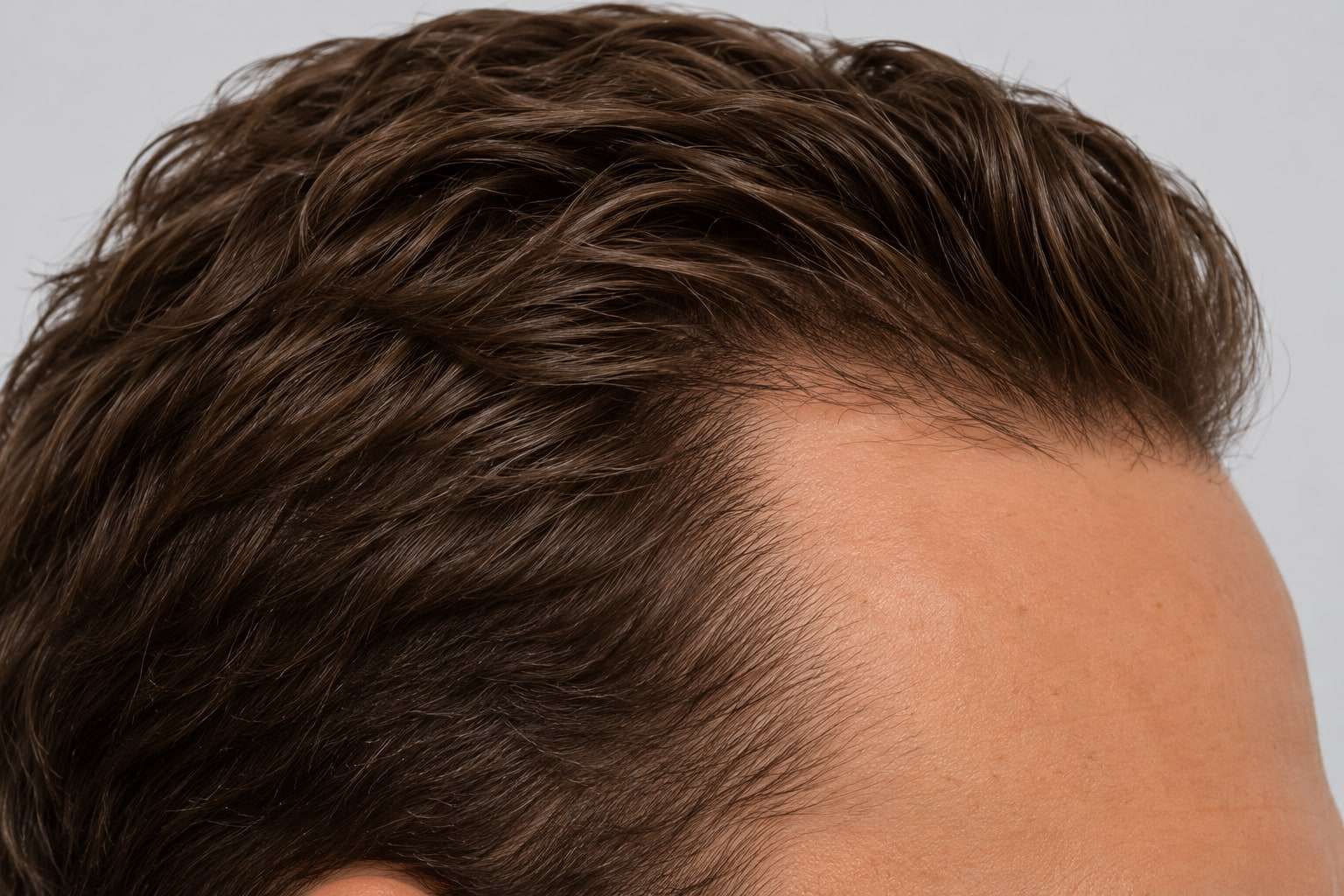
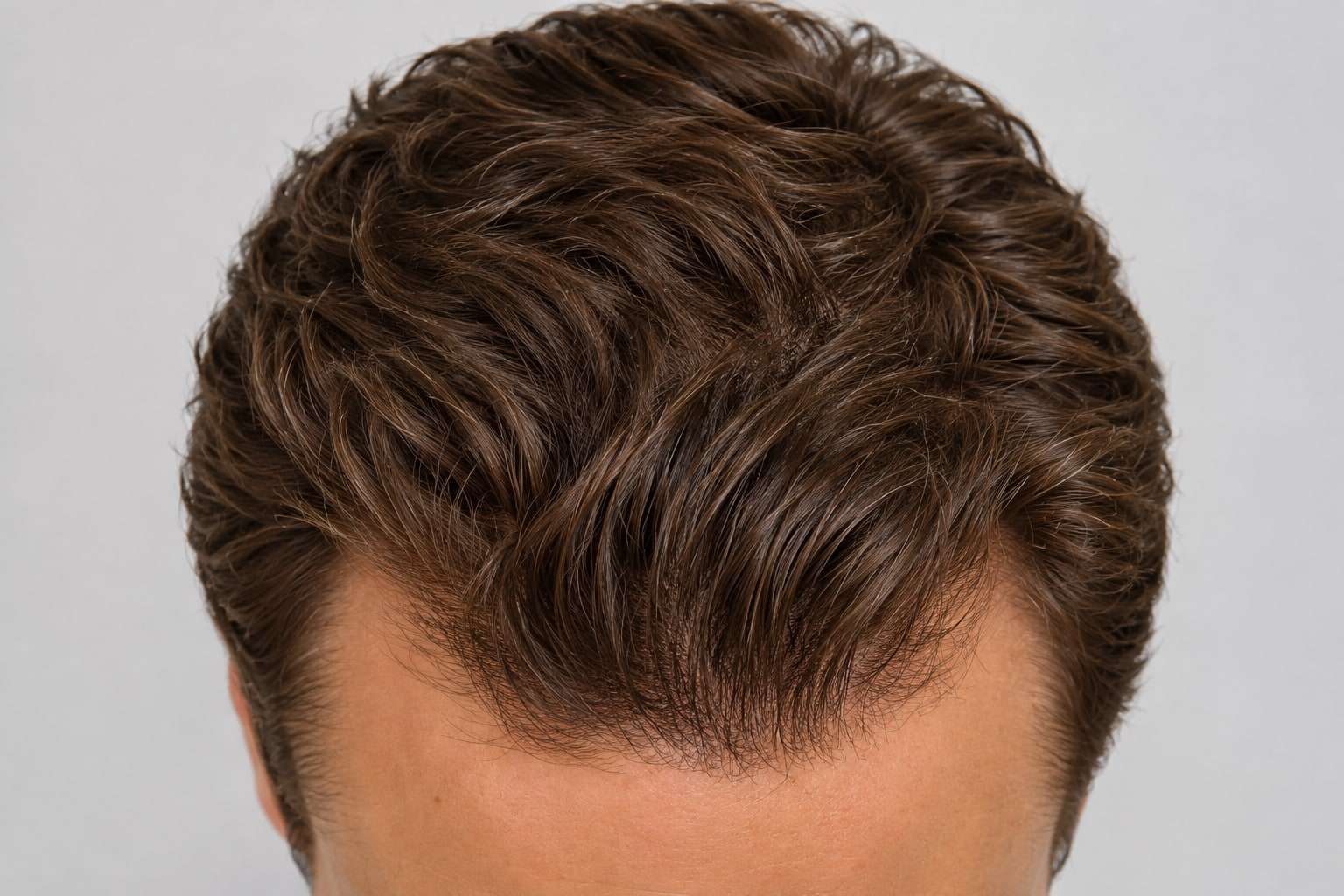
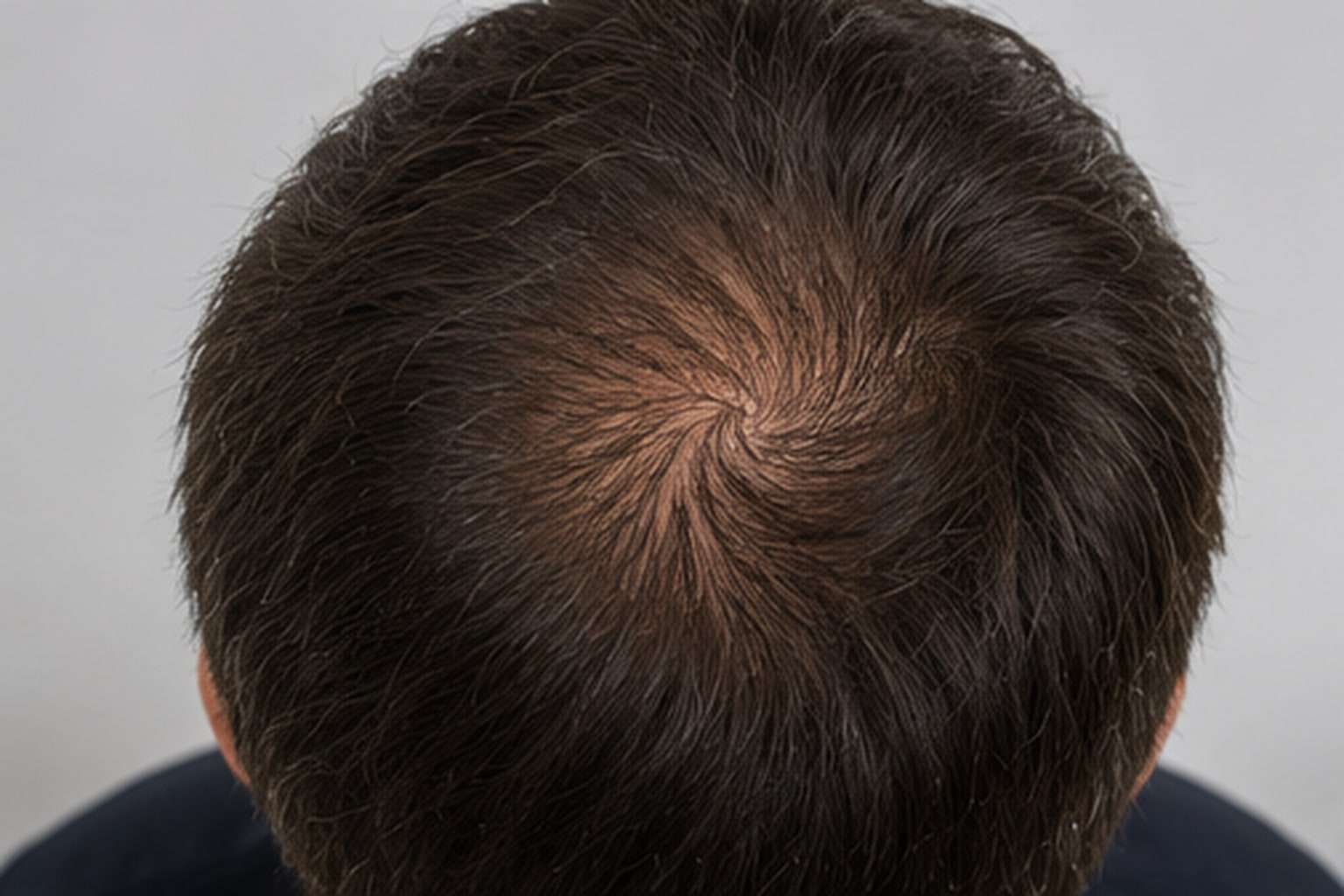
If you want a label for where you are, the Norwood scale and our stage finder give you a shared vocabulary for your photos.
Can you count hairs or measure density at home?
Clinics and trials count hairs in a marked area, which is hard to copy at home. A 2023 review of imaging tools says global photography used to rely on a film camera and stereotactic imaging equipment, and has been simplified by cameras that use software analysis and give adjustable outlines to match facial features, so views can be captured in a standard way. That’s a clinic setup, not a bathroom mirror.
What you can do cheaply is count in the same photo each time, such as the number of visible hairs along a marked 1 cm line of the part. It’s a crude check and we know of no study that validates it, so use it only as a prompt to look closer, not as a result.
One home count does have a study behind it, but it measures shedding, not density. In the 60-second hair count you comb your hair forward for one minute over a towel or pillowcase of a contrasting color, before washing it, and count the hairs that fall. A 2008 study of 60 healthy men aged 20 to 60 without hair loss found an average of about 10 hairs, with a range of 0 to 78 in men up to 40 and 0 to 43 in older men, and counts that stayed consistent from day to day. It was a small convenience sample from one hospital practice, so treat a high count as a reason to look closer, not a diagnosis.
What do scalp cameras add?
Trichoscopy is a close-up examination of the scalp and hair. A 2024 systematic review of 34 articles on male and female pattern hair loss found that the most common trichoscopic features were hairs of varying thickness (94% of patients), vellus hairs (66%) and the peripilar sign (43%). The authors say a patient’s history and clinical evaluation may be enough to diagnose most male cases, while in women trichoscopy should add to them.
A consumer scalp camera is a small USB or Wi-Fi microscope. Here is what we can and can’t say:
- It can show you close-up changes you can’t see in a mirror, such as whether the hairs in one patch look thinner or fuzzier than in another.
- We found no validation studies comparing consumer scalp cameras with clinical hair counts, and no study showing that the “hair density” or “scalp health” scores in their apps are accurate.
- Apps and AI scores are unproven for this use. The one recent AI measurement study we read is a case report on a single man with a patch of alopecia areata (a different condition from pattern baldness). Its authors call it a proof of concept that needs further validation, say the tool has limitations in pattern hair loss, where thinning is diffuse rather than patchy, and some of them work for the company that makes the tool.
- Repeating the exact spot is hard. This part is our reasoning, not a finding: at close range, a small shift in position or light changes what’s in frame, so two readings may not be comparable.
So a scalp camera is a nice-to-have for the curious, not a way to prove a treatment works. If you buy one, keep expectations low, keep it cheap, and keep taking your standard photos too. We don’t recommend a specific model, because we have no evidence on which ones are accurate.
When should you see a doctor?
Tracking tells you what is changing, not why. Get checked if your hair comes out in clumps, you have sudden patches, your scalp is sore, red or scaly, or you’re shedding heavily after illness, stress or weight loss. Those can point to something other than pattern baldness, such as telogen effluvium. A doctor can also use a dermatoscope and take a proper history, which a home camera can’t replace.
How long before you judge a treatment?
Not within the first weeks. Hair cycles are slow, and minoxidil can cause temporary shedding at the start. See our guides to minoxidil and finasteride for how long the trials ran, and to stopping hair loss for the full set of options. Keep taking photos through that wait: they’re what lets you judge fairly at month six instead of week three.
The bottom line
The best tracking tool is a boring one: a repeatable photo routine, started before you begin any treatment. A scalp camera can add detail, but there’s no good evidence its scores are reliable, so don’t let a number in an app decide your treatment. Your next step: take your baseline photos today, then read how minoxidil works so you know what to look for and when.
Sources
- Finasteride in the treatment of men with androgenetic alopecia. Finasteride Male Pattern Hair Loss Study Group (Randomized controlled trial, Journal of the American Academy of Dermatology, 1998)
- A practical guide to the standardization of hair loss photography for clinicians (Clinical guideline, Clinical and Experimental Dermatology, 2025)
- Imaging Tools for Noninvasive Hair Assessment (Review, Cutis, 2023)
- Trichoscopy of Androgenetic Alopecia: A Systematic Review (Review, Journal of Clinical Medicine, 2024)
- Artificial intelligence-based alopecia assessment: A proof of concept for enhancing accuracy and objectivity in hair loss measurement (Source, JAAD Case Reports, 2025)
- Standardizing the 60-second hair count (Study, Archives of Dermatology, 2008)
This article is for education only and is not medical advice. Talk to a doctor or dermatologist before starting or changing any treatment. Medical disclaimer