What Is the Crown (Vertex)? Thinning at the Back of the Top
CrownVertex
The crown, or vertex, is the top-back of the scalp around the whorl: one of the first places male pattern hair loss shows, and the hardest to see.
- Frontal hairline. The front edge. Often the first place a man notices loss.
- Temples. The corners of the hairline, which recede into an M shape.
- Mid-scalp. The top of the head between the hairline and the crown.
- Crown (vertex). The back of the top, where hair whorls. Hard to see in a mirror.
- Back and sides. Usually keeps its hair, even in advanced loss; the donor area for transplants.
At a glance
- Also called
- Vertex
- Where
- Top-back of the head, around the whorl
- Trial regions
- Vertex, mid-scalp, frontal hairline, temporal hairline
- Most studied
- The big finasteride trials enrolled men with crown loss
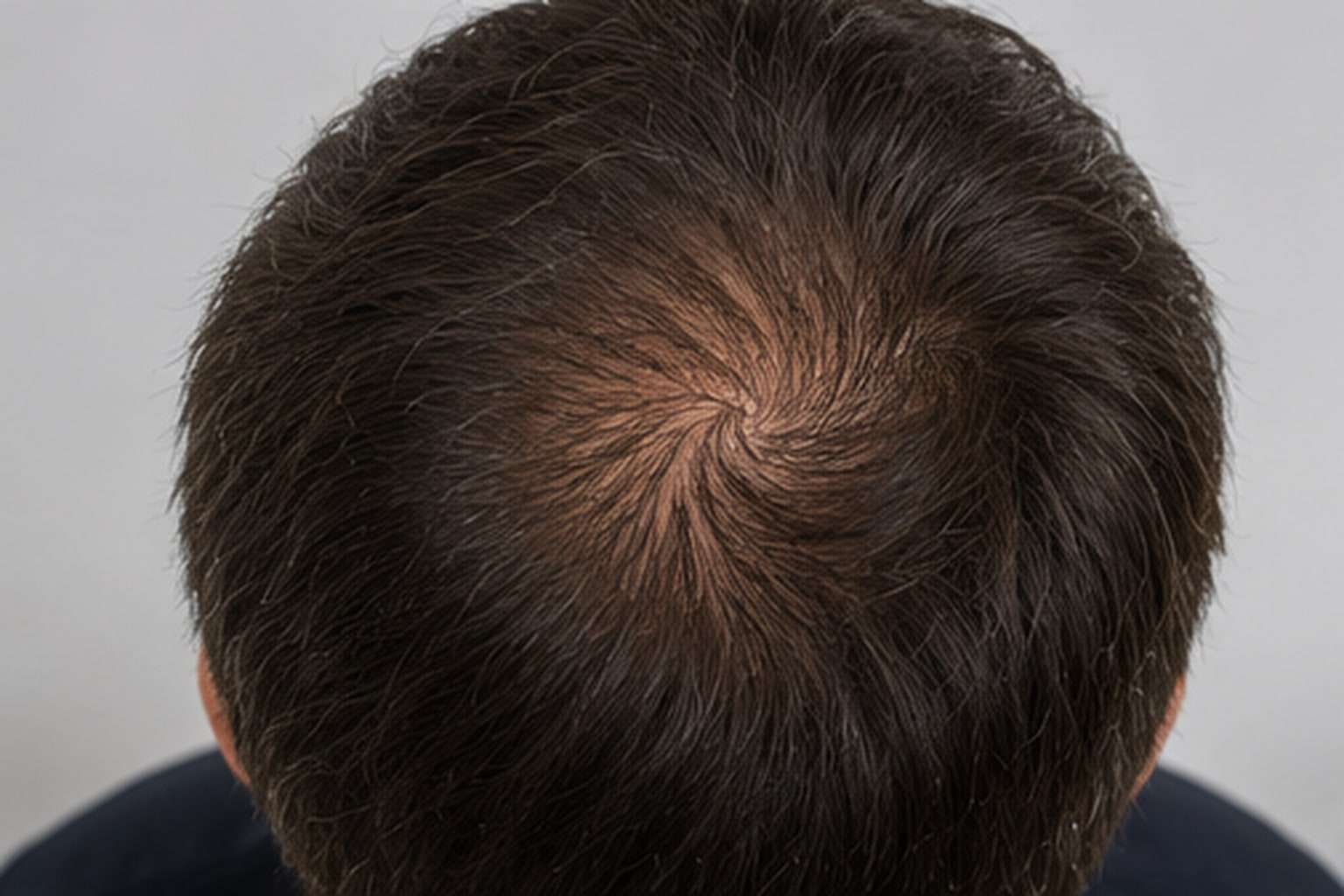
The crown is the top-back of your head, around the spot where hair grows in a spiral (the whorl). Doctors and studies call it the vertex. In male pattern hair loss it is one of the two places thinning usually starts, along with the hairline at the temples; the Norwood scale, built from a study of 1,000 men, includes crown thinning in its middle stages.
Why it’s easy to miss
You can’t see your own crown in a mirror. Many men first learn about it from a photo, an overhead light in an elevator or a barber’s comment. If you want to keep an eye on it, take a photo of the top of your head from above every few months, in the same spot with the same light, and compare.
The crown in research
Studies split the balding scalp into regions. A large finasteride trial program judged standardized photos of four regions: the vertex, the anterior/mid scalp, the frontal hairline and the temporal hairline. The crown gets the most attention for a practical reason: it is where hair is counted. In the two 1998 trials of 1,553 men, investigators counted hairs in a 1-inch circle on the balding vertex.
That has a catch worth knowing. Those trials enrolled men with vertex loss, so the strongest data are about the crown. When the photos of other regions were reviewed, finasteride grew hair in every region compared with placebo, but the authors warn the findings may not apply to men whose loss is mainly at the front.
Crown or hairline: does it change what you do?
For medical treatment, mostly not: the same options apply. It matters more for a transplant, where a large crown competes with the hairline for a limited supply of donor hair. Our guide to the Norwood scale shows how crown and hairline loss combine at each stage.
Published by the Say No to Baldness editorial team
Related terms
Sources
- Global photographic assessment of men aged 18 to 60 years with male pattern hair loss receiving finasteride 1 mg or placebo (Randomized controlled trial, Journal of the American Academy of Dermatology, 2012)
- Finasteride in the treatment of men with androgenetic alopecia. Finasteride Male Pattern Hair Loss Study Group (Randomized controlled trial, Journal of the American Academy of Dermatology, 1998)
- Male pattern baldness: classification and incidence (Study, Southern Medical Journal, 1975)